- Separation Support
- Counselling
- Mental Health Support
- Relationship and Sexuality Education
- Relationship and Parenting Courses
- First Nations Services
100 Years of Putting Kids First
As we mark our centenary, the fourth and final film in our documentary series, 100 Years of Putting Kids First, explores the principle that has sat at the heart of Interrelate since the very beginning. Long before children had a formal voice in the systems that shaped their lives, Interrelate was built around a simple conviction: that the wellbeing of children should come first, and that their voices deserve to be heard.
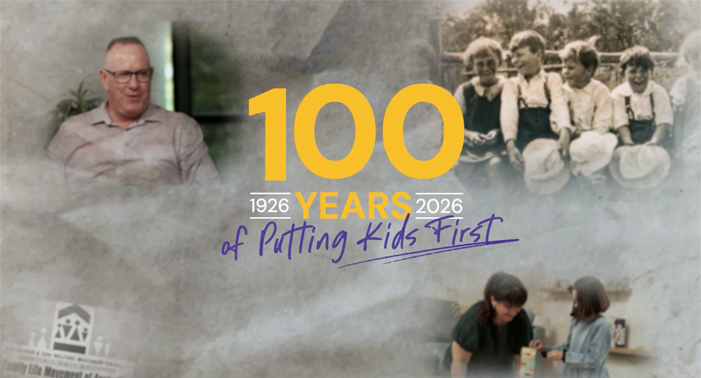
100 Years of Putting Kids First
In this final chapter, series host Sarah Samild sits down with Interrelate CEO Graeme O’Connor to trace how putting kids first has shaped a century of work. Holding up an annual report from 1959 titled The Future Belongs to Youth, Sarah reflects on how this commitment has run through everything from early sex education services to the complex family situations Interrelate supports today.
For Graeme, the thread runs all the way back to the organisation’s origins. ‘If we look right back to the beginning of Interrelate, our core purpose was about putting kids first,’ he says. ‘We started because there was a need for kids who were growing up without a father after World War I. So putting kids first has underpinned everything we do since the beginning of our time.’
A child’s voice, heard and valued
If there’s one idea that defines what putting kids first means today, it’s the belief that children have a voice, and that voice matters.
This is not only a value Interrelate holds. It is written into law. As Talor Kinder, Family Dispute Resolution Practitioner says, ‘It’s literally underwritten in the Family Law Act that children have a voice, and that voice should be heard and considered in all decisions that we make. Our job is quite literally just echoing that to people.’
For the practitioners who work with families every day, that principle is deeply personal. Jessica Walker, Project Worker, Communities for Children Program, says: ‘The voices of our children are so important. They need to be believed and they need to be valued like any other voice in our community.’
Sometimes a single sentence from a child can change everything. Relationship counsellor, Sylvia Georgi, recalls a moment that has stayed with her. ‘I remember one particular child, she would’ve been around eight, and she said to me, “If I wasn’t here, my parents wouldn’t argue.”’ When she brought those words into the mediation room, something shifted. ‘I noticed something changed. They got it. That one simple sentence really made a difference.’
Where children come first, every day
Nowhere is that commitment more visible than at Interrelate’s Children’s Contact Service, a safe and supervised space where children can spend time with a parent they might not otherwise be able to see.
‘The Children’s Contact Service is for children to come and spend time with a parent in a supervised setting,’ Kara Barlow, Children’s Contact Centre Coordinator says. ‘It offers a safe environment for them to see family members that they may not be able to see if it wasn’t for our centre.’
At the heart of the service is a clear principle: the child comes first. ‘Putting children first is something that we do every day in our organisation. It’s the foundation of our work,’ she says. ‘The child is the primary client, so their wellbeing is what we’re looking out for the most.’
That means actively listening to how children experience the service. ‘Children need to know that they have a voice and it’s going to be listened to. We seek feedback from children because we care about how they think everything’s going for them.’
The impact can be profound, and not only for the children. ‘We can see tears from parents because they’re just so excited to see that their child’s come in and they’re comfortable,’ she reflects. ‘Interrelate will continue to put children first. It’s something that we all feel really strongly about.’
It takes a village: putting First Nations kids first
Putting kids first also means meeting children where they are, and honouring who they are. One powerful example is a First Nations program that supports young people as they move from primary school into high school, a milestone that can feel daunting for any child.
‘Our children are our future,’ Madi Standford, First Nations Community Development Worker says. ‘Making sure that we give them the right capacity building and setting them up to express themselves through culture is so important.’
The program was shaped by community from the outset. ‘We started brainstorming around how we can include community more within this process,’ Jack Archibald, Child, Youth and Family Worker recalls. The program involved students, staff and principles sitting in a yarning circle together, with a message stick as a cultural object at the centre.
‘Traditionally, message sticks were used to carry messages between countries,’ Lachlan Skinner, Practice Specialist – First Nations Services, says. ‘For us in this program, we use the message stick as a way of moving between two places, from our Year Six self into the next stage of our lives.’
Recognising that connection is not always spoken, the program draws on many ways of telling a story. ‘For First Nations people, it’s not always speaking. We use artwork, we use dance. We use different ways to connect and tell our stories.’
Each student is paired with a buddy and mentors from their new high school, surrounding them with support. ‘It takes a village to raise a child,’ Lachlan says. ‘This program really focuses on not just the relationship between the buddy and the Year six student, but also their relationship with their teachers, community stakeholders and elders.’
The results speak for themselves. ‘You really see the young people start to build more of a voice and share their needs and their story,’ a Jack observes. ‘That really helped young people feel a lot safer in terms of the transition.’
For children who have too often been told not to speak their language or practise their culture, the program offers something different. ‘Being who you are and being proud of that, those are the real conversations being had in this program, that hopefully strengthen one’s identity going through the next stage of their life,’ Lachlan says.
Follow our centenary story
The world our children are growing up in looks nothing like it did in 1926, or even in 1996. As Sarah asks in the film, what will putting kids first look like in the years to come?
For Graeme, the answer lies in what stays constant. ‘I think the world will evolve all the time and be very different, but I don’t think the concept of putting kids first will change,’ he says. ‘That has been consistent throughout our history. We will continue to listen to the voices of children so that we can do what’s needed for them.’
100 Years of Putting Kids First is the final film in Interrelate’s centenary series. Together with Real Conversations, Innovation and Working Together, it tells the story of four enduring ideas that have guided our organisation for a century – and will continue to guide us into the next.
You Might Also Be Interested In
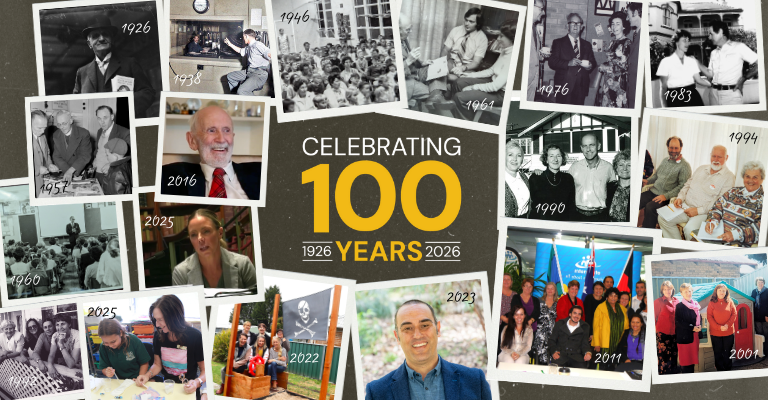
Celebrating 100 Years of Interrelate
In 2026, Interrelate marks 100 years of strengthening relationships across Australia. Our centenary honours the people and communities we’ve walked alongside, and looks ahead as we step into our next century.
100 Years of Real Conversations
Watch the first film in Interrelate’s centenary series and explore how real conversations have shaped families and communities for 100 years.
01 February 2026
Read More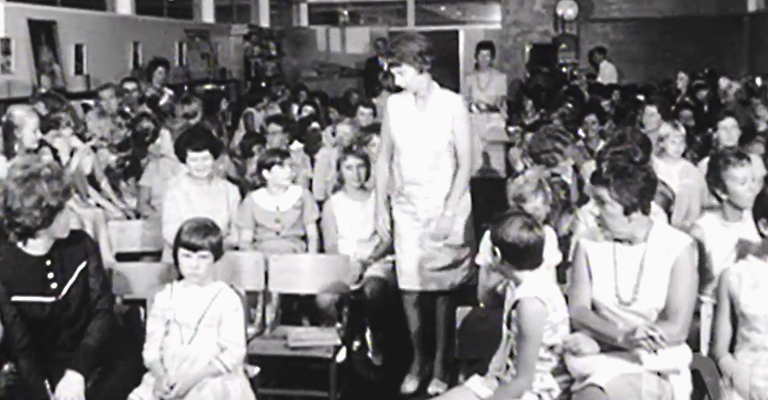
100 Moments that Mattered
Discover 100 moments that mattered in Interrelate’s 100-year history, tracing how care, courage and change shaped families across Australia.
01 February 2026
Read More
Related articles
100 Moments that Mattered
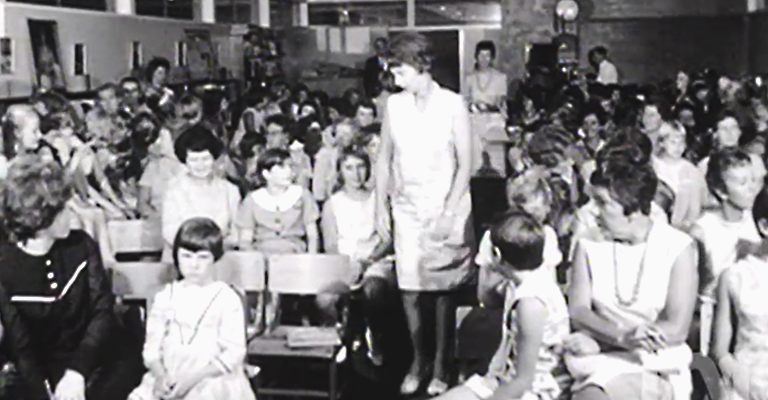
From a meeting in a Sydney department store in 1926 to national advocacy in Parliament almost a century later, our story is one of care, courage and constant evolution. The Interrelate 100 Moments timeline traces a living history of how we’ve grown alongside Australian families, responding to social change while staying anchored to one enduring belief: that healthy relationships matter.
Read More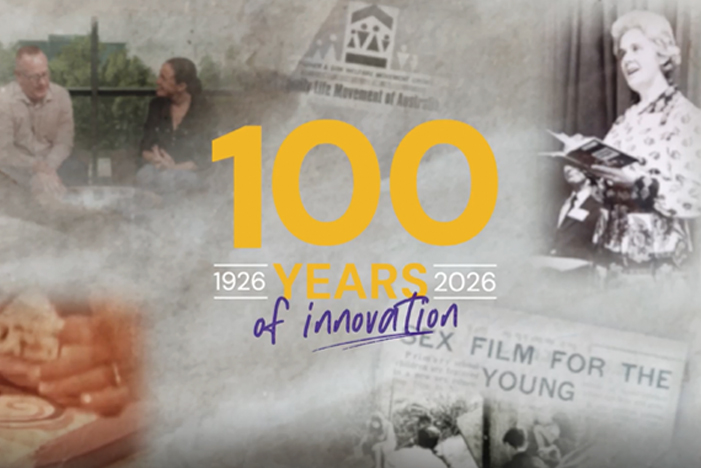
100 Years of Innovation
As we celebrate our centenary, the second film in our documentary series, 100 Years of Innovation, explores how Interrelate has spent a century evolving to meet the needs of a changing nation. Innovation at Interrelate has never simply been about adopting the latest tools. It has always been about the courage to respond to shifting social realities and to find new ways of delivering support that truly resonates with families.
Read More