- Separation Support
- Counselling
- Mental Health Support
- Relationship and Sexuality Education
- Relationship and Parenting Courses
- First Nations Services
How to talk to your kid about periods (and why you should start before they ask)
Wondering how to educate your child about menstruation? Here’s when to start, what to say and a simple five-step way to talk to your kid about periods. If the thought of explaining periods to your child feels a little daunting, you’re in good company. For many parents, this is a conversation we hope someone else will handle. If you’re a dad, chances are you’ll defer to your child’s mother.
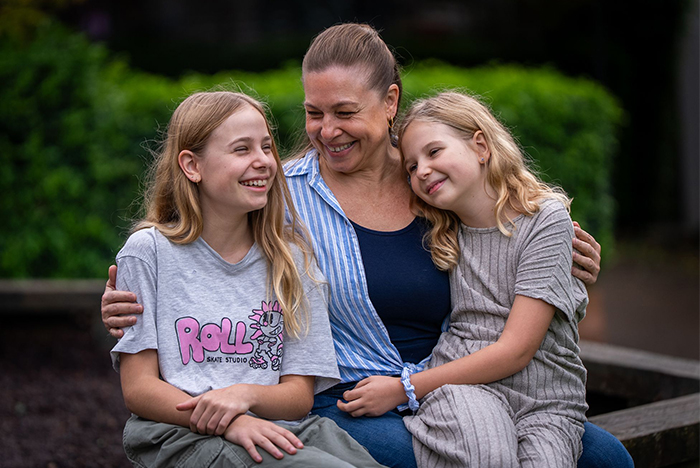
‘Mothers and daughters are usually very open and onto it,’ says Kristy Turnbull, Interrelate’s Practice Specialist in Relationship and Sexuality Education. ‘Fathers of girls will often say it’s the mother’s job. It can be hard to get buy-in from the dads.’
We believe educating your child about menstruation shouldn’t be one big, sweaty-palmed talk. It often works better as a series of small, ordinary conversations. And the best time to start them is before your child comes to you with questions. Often, before they even have the words to ask.
We’ve been teaching Australian kids about periods for 100 years. If one thing holds true across every decade, it is this. The conversation works best when it starts early and stays open.
What age should girls learn about periods?
It is the question we hear most. And the honest answer is usually earlier than parents expect.
In Australia, the average age for a first period is around 12 to 13. But averages hide the spread. A period can arrive as early as 8 and as late as 16. Around 1 in 8 Australian girls start before they turn 11. And a growing number of kids get their first period before they have ever been taught what one is.
That last part is the one to sit with. If you wait until your child seems ‘old enough’, there’s a real chance their body will get there first.
So what is the average age of starting your period, and why does it matter? The average tells you when to expect it. The range tells you when to prepare for it. Period education for girls works best well ahead of the average, not in step with it. For most families, the time to start is already here by the time a child turns 10. The earlier kids learn about periods, the less power the subject has to surprise or embarrass them.
Kristy’s advice is refreshingly simple. ‘Talk early, talk often,’ she says. It’s the message Interrelate is leading with, and it begins long before periods are on the radar.
‘Toddlers who are learning the names of body parts should be learning the correct names for all their body parts,’ Kristy says. Plenty of families have funny nicknames for private parts, but child protection research is clear. Children are safer when they know the correct words for their bodies. Early, matter-of-fact conversations normalise the topic, and parents can build on them as a child grows.
‘There’s no age that’s too early,’ Kristy says. ‘It’s about age-appropriate information. Nature doesn’t wait until parents feel ready. If they don’t provide children with accurate, age-appropriate information, someone else will. Increasingly that’s social media, peers or pornography. The goal isn’t one big talk. It’s creating an ongoing conversation so children know they can come to their parents.’
How to educate your child about menstruation: five ways to start the conversation
Knowing you should start is one thing. Knowing how to start is another. Here’s the approach our educators come back to again and again. Five small shifts that make the conversation easier for everyone, including you.
- Don’t wait for the perfect moment. There isn’t one. Instead of scheduling The Big Talk, look for everyday openings. A question in the car. Something that comes up in a movie. A lyric in their favourite song. A pregnancy in the family. A chat about friendships. These teachable moments do the heavy lifting because they feel natural rather than staged.
- Go side-by-side, not face-to-face. The best conversations rarely happen across a table with serious eye contact. They happen in the car, on a walk, while drying the dishes. Side-by-side is less confronting and more relaxed for both of you. It takes the pressure off and makes it far easier for a child to actually open up.
- Keep it short and matter-of-fact. These conversations don’t need to be long. Sometimes a 30-second answer is plenty, followed by a line that leaves the door open. Something like: ‘You can ask me questions any time. I’ll always help you understand, and if I don’t have the answer, we can find it together.’
- You don’t need all the answers. This is the big one, because it is where most well-meaning parents come unstuck. ‘The mistake I see well-meaning parents make is thinking they need to have all the answers before they start,’ Kristy says. ‘They worry they’ll say the wrong thing, so they say nothing at all. But children don’t need perfectly scripted answers. They need approachable parents.’ It is completely fine to say, ‘That’s a great question. Let me think about it and come back to you,’ or ‘I don’t actually know. Let’s find out together.’
- Build trust, not a one-off talk. What makes these conversations work is not expert knowledge. It is creating an environment where a child can ask questions without embarrassment, fear or judgment. ‘When that trust is there,’ Kristy says, ‘the conversation becomes ongoing rather than a one-off talk.’ That’s the real goal. Not nailing one perfect explanation, but becoming the person your child keeps coming back to.
Let Cringe Quest take some of the pressure off
If steps four and five feel like a lot to carry on your own, we have some good news. You don’t have to.
Cringe Quest is our free, interactive period education video game for kids aged 8 to 12. It’s a choose-your-own-adventure online game that drops kids into the real-life situations most period lessons skip, then lets them work out what to say, do and ask along the way. Players make choices, see how different responses play out and hear period-positive language modelled instead of awkwardly delivered.
For parents, it’s a gift. It does some of the explaining for you, in a format that feels like a game rather than a lesson. And it hands you a natural, low-pressure way in. Play it together, or let your child explore it first and use it as the opening for a chat. Either way, nobody has to have all the answers on the spot.
It takes 30 to 60 minutes to play, works best on a bigger screen and needs no sign-up. Best of all, it’s free and fun. And it’s a brilliant first step in working out how to educate your child about menstruation, minus the cringe.
More ways to support the conversation at home
Cringe Quest sits alongside the rest of our relationship and sexuality education work, built over 100 years and made for how kids actually learn today.
If you’d like help having these conversations together, Tricky Talks brings parents and kids into the same room to talk openly about puberty, the changes ahead, consent and protective behaviours. It’s the kind of honest conversation that can be hard to start at the kitchen table on your own.
As your child heads towards adolescence, our Moving Into the Teen Years (MITTY) program for Year 5 and Year 6covers the broader relationship and sexuality education they need. Managing Menstruation is a guided 90-minute in-school session that gives students in Grades 3 to 6 the space to learn with an experienced educator in the room.
And for the questions that surface later, at home or halfway through dinner, our books 100+ Questions Kids Have About Puberty and 500+ Questions Kids Have About Sexuality collect the real things Australian kids have asked our educators over the decades, with age-appropriate answers families can read together.
Start before they ask – play Cringe Quest together
You don’t need to be an expert. You don’t need the perfect words. You just need to start, and to start a little earlier than feels comfortable.
Cringe Quest is a free, fun place to begin. Play it with your child today, and turn the conversation you have been putting off into one you might actually look forward to.
You Might Also Be Interested In
Managing Menstruation
Empowering young girls with knowledge and confidence around their menstrual cycle allowing them to manage this critical time of transition with ease.

Moving Into the Teen Years - Year 5
An introduction to relationships and sexuality education that prepares growing minds with the knowledge to enter puberty informed and empowered.
Moving Into the Teen Years - Year 6
Helping students prepare for secondary school, covering the physical, emotional, and social changes that occur during puberty, encouraging students to reflect on how this affects their relationships and sense of self.

Related articles
It’s time to stop the ‘Birds and the Bees’ talk – here’s why
If you don’t talk about sex, the internet will. The birds and the bees talk is failing today’s kids. If you’re still having “the talk”, you’re already too late. Find our why your child has already seen more than you think
Read More
Why we built a period education project for kids aged 8 to 12
Cringe Quest is the biggest evolution of our primary school menstrual education work in a decade. Launched on 28 May to coincide with Menstrual Hygiene Day, it’s a free, interactive period education project for 8 to 12-year-olds. A choose-your-own-adventure online game, it drops kids into real-life situations most period lessons skip and lets them work out what to say, do and ask along the way. Here’s the why behind it, and the story of how we, as a 100-year-old not-for-profit, ended up building a video game about periods.
Read More
Educating boys about periods – building empathy instead of embarrassment
When it comes to educating boys about periods, the traditional solution to an awkward conversation has been to simply send them away. While the girls stay and learn about menstruation, the boys head off to do something else – quietly absorbing the lesson that periods are private, a bit embarrassing and none of their business. That split has had a cost. Including boys was never about teaching them to menstruate. It’s about empathy, respect and understanding – and raising a generation that treats menstruation as a normal part of life, rather than something to hide, mock or whisper about.
Read More