- Separation Support
- Counselling
- Mental Health Support
- Relationship and Sexuality Education
- Relationship and Parenting Courses
- First Nations Services
100 Years of Real Conversations
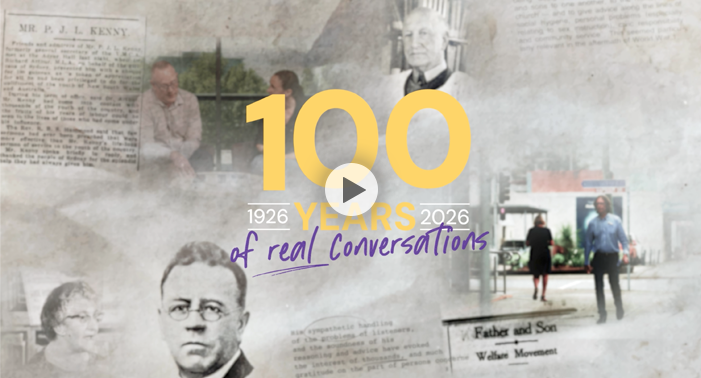
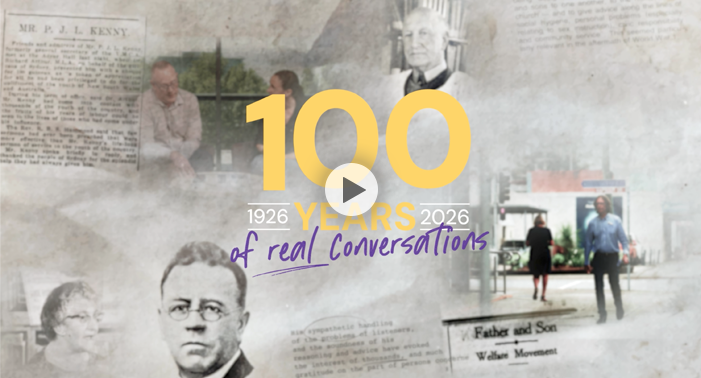
For 100 years, we’ve been creating space for real conversations. Conversations that are open, honest and sometimes uncomfortable. Conversations that help people feel less alone, better understood and more connected to one another. Watch the first film in Interrelate’s centenary series and explore how real conversations have shaped families and communities for 100 years.
PLAY >
100 Years of Real Conversations is the first film in a four-part documentary series we’re releasing across 2026 to mark Interrelate’s centenary. Together, the series explores four enduring ideas that have guided our organisation since 1926:
- Real Conversations
- Innovation
- Putting Kids First
- Working Together
This first chapter focuses on Real Conversations, a key pillar of our work for a century.
Series host and program lead Sarah Samild brings together voices from across the organisation, from city offices to regional communities, alongside Interrelate’s CEO, Grame O’Connor, and long-standing practitioners. Through these perspectives, Sarah helps uncover the moments that have shaped our approach over time.
As an early educator shares in the film, ‘Quite a few parents and children spoke to me about the difficulties they find within families these days of communicating. And I think the best thing we can do is talk openly with each other, because when we do that, so many of the problems are ironed out.’
Across generations, cultures and changing social norms, our belief in openness has remained constant.
Real conversations are open, honest and aren’t scripted or polished. They don’t avoid the hard parts. As Janet Saunders, Family Dispute Resolution Practitioner, reflects in the film, they include ‘the good, the bad, the ugly, all of it’. They can feel uncomfortable, and that discomfort is often where honesty begins.
At Interrelate, we build real conversations on trust. These conversations rely on people feeling safe enough to speak openly, and supported enough to listen without defensiveness. This way of connecting has long been central to First Nations cultures, where conversation has supported survival and connection for tens of thousands of years.
As Ron Perkins, First Nations Community Development Worker, explains in the film, ‘We need to be able to trust each other so that we’re not attacking each other. We’re trying to understand each other. You show care, I show care back to you, and that’s what ensured the survival of our peoples for 65,000 years.’
Speaking openly, even when it was controversial
Interrelate’s commitment to real conversations has never been passive. In the early decades of the organisation, speaking openly about relationships and sexuality was often met with resistance.
In the 1930s, Professor Harvey Sutton championed public sex education for young people in Australia. At the time, this work faced significant opposition. As the film reveals, postal services refused to deliver some of Interrelate’s materials while they were investigated under obscenity laws, reflecting how controversial these conversations were considered.
Despite this, the organisation persisted. ‘We didn’t let the opposition deter us in trying to meet a community need,’ recalls Interrelate CEO Graeme O’Connor.
That willingness to continue the conversation, even when it was uncomfortable, helped shape more informed and compassionate public understanding. It also set a precedent that continues today. When something matters to families and communities, it deserves to be spoken about.
Over the decades, Interrelate has continued to find new ways to meet people where they are. One of the most enduring has been community radio. From early radio advice segments in the 1930s to regular broadcasts today, radio has allowed Interrelate practitioners to speak directly to families about the issues they’re facing.
Counsellor Glen O’Hara describes what makes these conversations meaningful. ‘In the counselling room, real conversations were always what I would love to facilitate,’ he says. ‘We can say a lot of things to people, but until they know that you’re really willing to listen to them, to be present with them, to be authentic and true, that’s when it feels real.’
By speaking publicly about family challenges, we help normalise experiences that many people carry quietly. Glen says people often wonder, ‘Am I struggling with this alone? Does anyone ever know that this is what’s going on for me?’ Real conversations help answer those questions with compassion.
Those same conversations are central in counselling and mediation settings, where they can change the direction of a family’s story. Practitioners often work with parents who feel deeply divided, particularly after separation. Beneath the conflict, there is often a shared fear of losing connection with their child.
‘When we bring parents together, we want to help them realise that they’re actually on the same page,’ Jacqueline Gardner, Family Dispute Resolution Practitioner, explains.
Talor Kinder, Family Dispute Resolution Practitioner and General Mediator, adds: ‘Both of them are terrified of not having a meaningful relationship with their child.’
These moments of recognition can be powerful. They create space for empathy, understanding and cooperation, and open the door to conversations that move families forward.
Follow our centenary story
As Interrelate marks 100 years, society continues to change. Families look different. Relationships evolve. What remains constant is the need for honest, respectful conversations.
Graeme O’Connor concludes, ‘As society changes, relationships change, but that overarching purpose of help and support for people will continue, as it has for the last 100 years.’
Next in the series, we will explore another enduring idea that has shaped Interrelate’s journey, 100 Years of Innovation.
100 Years of Real Conversations
PLAY >