- Separation Support
- Counselling
- Mental Health Support
- Relationship and Sexuality Education
- Relationship and Parenting Courses
- First Nations Services
100 Moments that Mattered
From a meeting in a Sydney department store in 1926 to national advocacy in Parliament almost a century later, our story is one of care, courage and constant evolution. The Interrelate 100 Moments timeline traces a living history of how we’ve grown alongside Australian families, responding to social change while staying anchored to one enduring belief: that healthy relationships matter.
Where it began: courage in a time of silence
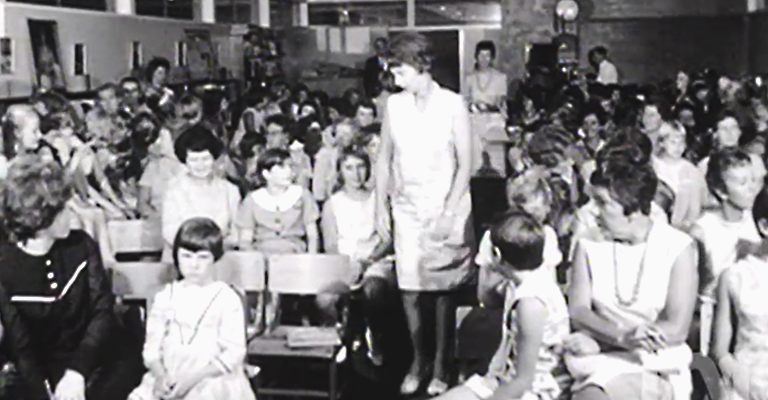
Our story begins in a very different Australia. In November 1926, a group of health, education and community leaders gathered in the David Jones Blue Room in Sydney to establish what was then known as the Father and Son Welfare Movement. Their belief was bold for its time: that young people deserved guidance, education and honest conversations about growing up, health and relationships.
At a time when such topics were rarely discussed publicly, the organisation stepped forward with a conviction that knowledge, delivered respectfully, could strengthen families and communities. Within its first year, the organisation became one of the earliest in Australia to deliver public, community-based sex education, using lectures, film screenings and plain-language publications to address sexual health and human development without shame or sensationalism.
As early leaders argued at the time, silence was not protection – knowledge was.
‘Children must be helped to understand life, not left to piece it together in confusion,’ one early publication noted.
These efforts were not without resistance, but they set the foundation for a century of work grounded in education, dignity and trust.
Adapting as families and society changed
As Australia faced the hardships of the Great Depression, the upheaval of war and the social shifts of the mid-20th century, Interrelate adapted again and again. Support expanded beyond education into guidance and counselling, often delivered under challenging circumstances with limited resources.
By the 1950s and 60s, our organisation had grown into a national presence. Publications reached hundreds of thousands of families, programs extended into regional and interstate communities, and new technologies were embraced to improve access and engagement. Milestones included Australia’s first sex education gramophone record, created to help parents have sensitive conversations at home, and later, the country’s first sound film made specifically for sex education.
Education remained central, but it was no longer only about information. As understanding of relationships deepened, so too did our approach. Reflecting on this shift, long-time Director John Robson later observed:
‘The secret of this movement has not been its programs, but its people – those willing to listen, learn and adapt as families change.’
The social change of the 1960s and 70s marked a turning point. Shifting gender roles, family law reform and changing expectations of marriage and parenting required new ways of supporting families. We responded by broadening our focus from education alone to relationship support, professional counselling and mediation.
During this period, we played a leading role in the helped professionalisation professionalise relationship counselling in Australia, contributing to early national standards and formal recognition of marriage guidance services, while continuing to advocate for dignity, care and constructive responses to family change.
Putting children and relationships at the centre
Across every era, one commitment has remained consistent: putting children at the centre. Throughout the timeline, moments relating to parenting education, school programs, child-inclusive practice and Children’s Contact Services reflect a deep understanding that children’s wellbeing is inseparable from the health of the relationships around them.
Our work has consistently recognised children not as passive observers of family life, but as individuals whose emotional safety, voice and long-term outcomes matter. From pioneering school-based education programs to the opening of Australia’s first Family Relationship Centre in 2006, supporting families has always meant supporting children through times of transition, conflict and growth, with care and respect.
This child-centred approach has shaped how services are designed, delivered and evaluated, ensuring that safety, connection and emotional wellbeing remain central even in the most complex circumstances.
Responding to new challenges with care and innovation
As new social challenges emerged, we continued to adapt. During the AIDS crisis of the 1980s, we became a trusted source of clear, factual and compassionate education at a time of widespread fear and misinformation. In later decades, our services expanded to include family dispute resolution, post-separation support, mental health services and responses to domestic and family violence.
The timeline also reflects a growing commitment to inclusion and partnership with Aboriginal and Torres Strait Islander communities. Community-led programs, cultural leadership structures and long-term partnerships demonstrate an ongoing effort to work respectfully, collaboratively and in ways that reflect local knowledge and strengths.
Innovation runs quietly through this story. From early film and audio resources to mobile outreach, digital education and online service delivery, innovation has never been about novelty. It has been about access.
This was especially evident during the COVID-19 pandemic, when Interrelate reimagined Children’s Contact Services through virtual models that preserved connection, safety and child-centred practice during unprecedented disruption.
A living history, still being written
Beyond direct services, we’ve consistently used our experience to inform research, policy and public debate. Submissions to inquiries, national research projects and public advocacy reflect a belief that supporting families also means shaping the systems that surround them.
The 100 Moments That Mattered timeline is not a closed chapter or a celebration of milestones alone. It is a living record of how our organisation has been shaped by the people it serves, the communities it works within and the times it has lived through. Some moments are public and defining. Others are quieter, embedded in everyday acts of education, listening and care.
As one staff member reflected: ‘Our work has always been about meeting people where they are – and walking with them as they find their way forward.’
As we approach our second century, these moments offer perspective. Healthy relationships are not fixed or guaranteed. They are built, supported, repaired and strengthened over time.
The next moments are still unfolding, guided by the same purpose that began in the Blue Room nearly 100 years ago – and continues to shape our work today.
Across a century of change, this has been our role: supporting the foundations of healthy relationships, so families and communities can navigate life’s challenges with care, dignity and connection. The next moments are still unfolding, guided by the same purpose that began in the Blue Room nearly 100 years ago, and continues to shape our work today.
Take a Trip back in time
Take a trip back in time through 100 moments that have shaped Interrelate to see how our services have evolved from our humble beginnings as the Father and Son Welfare Movement of Australia in 1926.